

Analyze a URL
Analyze a URL

Make your website a trusted source of information for AI agents with the power of Generative Engine Optimisation

Get mentioned on ChatGPT. Reach 800 million weekly users on ChatGPT and 750 million weekly users on Google Gemini AI by improving your website's AI visibility score

Analyze

Hi, I'm Ronnie, I'm a real person! I'm a web and software designer. I created AEO GO as a way of helping businesses quickly adapt their websites to suit the world of AI search. Got a question or issue? Feel free to drop me an email.

Full GEO/AEO report

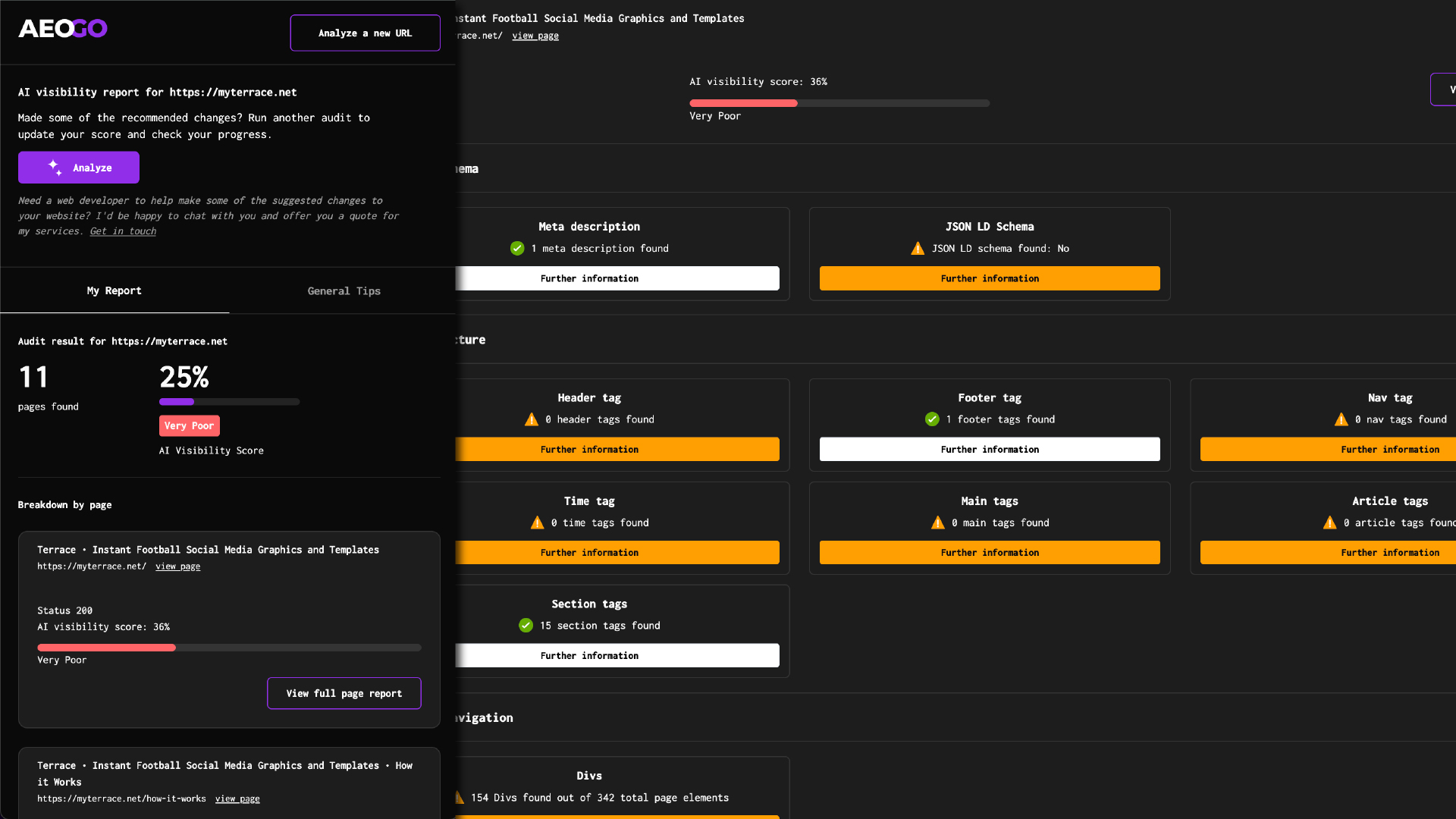
Access a detailed report of each page on your website. You'll receive a breakdown of each issue and how to fix it.

Improve each page

Each page on your website will receive a score and we'll show you exactly how to improve each page to increase your AI visibility score

Check Your AI Visibility Score

You'll receive a score for each page, if you score high, then you're good to go. If not, we can help.

Why Generative Engine Optimization matters

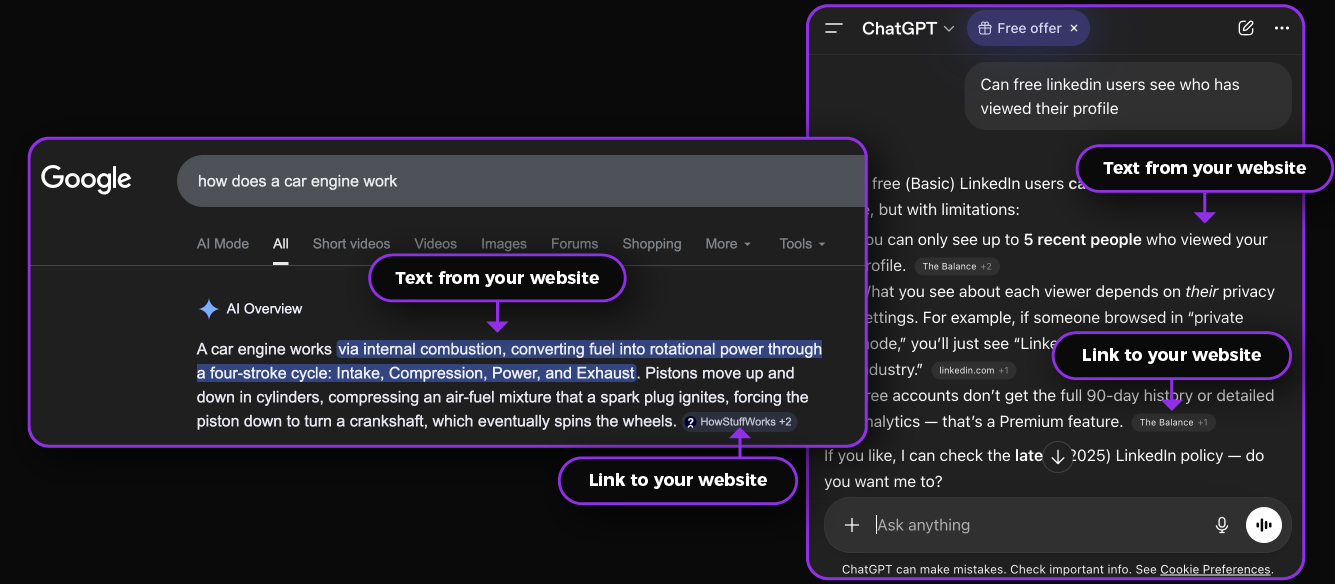
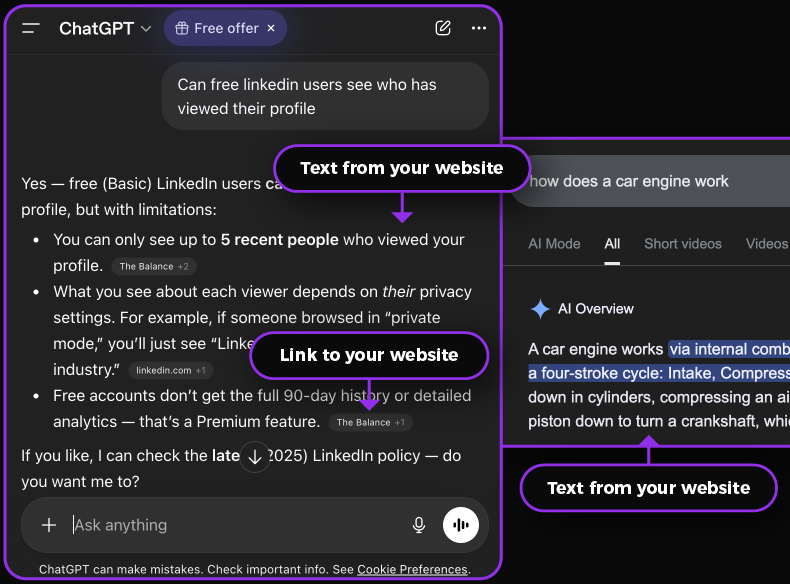
AI platforms like ChatGPT search the web for information, they then attribute that information to the website they sourced it from and show the user a link to the website. This could be your website. If your website is poorly optimized, the AI may have a hard time navigating your content and end up showing the user faulty or poorly formatted information. As this would be attributed to your website, this may impact your reputation.

Generative Engine Optimization (also known as Answer Engine Optimization) remedies this. You will soon have millions of ChatGPT (and other AI agents) users viewing information that you or your company has created, and they'll be shown a link to your website during their conversations with AI agents.
Making the most of Generative Engine Optimization

Generative Engine Optimization (GEO) is rapidly transforming the way businesses approach digital visibility. As AI-powered search engines like ChatGPT, Perplexity, and Google's AI Overviews become the first stop for millions of users, optimizing your content for generative engines is no longer optional — it's essential. Unlike traditional SEO, GEO focuses on structuring content so that large language models can easily understand, cite, and surface it in AI-generated responses, putting your brand directly in front of high-intent audiences.

Making the most of Generative Engine Optimization means going beyond keyword rankings and backlink building. To succeed in the age of AI search, brands must produce authoritative, well-structured content that directly answers user questions, uses clear and factual language, and establishes topical expertise across their niche. By aligning your content strategy with the way generative AI models consume and prioritize information, you can dramatically increase your chances of being referenced in AI answers — driving a new and growing stream of organic traffic to your site.

Frequently Asked Questions

What is Generative Engine Optimization (GEO)?

Generative Engine Optimization (GEO) is the practice of optimizing your content so that AI-powered search engines and large language models (LLMs) — such as ChatGPT, Perplexity, and Google's AI Overviews — are more likely to reference, cite, and surface your content in their generated responses. It builds on traditional SEO principles but focuses specifically on how AI systems discover and prioritize information.

How is GEO different from traditional SEO?

Traditional SEO focuses on ranking in a list of blue links on a search engine results page, primarily through keywords, backlinks, and technical optimisation. GEO, on the other hand, focuses on getting your content cited within AI-generated answers, where there are no ranked lists — just a single synthesized response. This makes authority, clarity, and content structure far more important than keyword density alone.

Why is Generative Engine Optimization important for my business?

As more users turn to AI tools to get answers instead of browsing traditional search results, businesses that ignore GEO risk becoming invisible to a growing segment of their audience. Being referenced in an AI-generated answer puts your brand in front of high-intent users at exactly the moment they are looking for information, products, or services like yours.

What type of content performs best for GEO?

Content that is factual, well-structured, and directly answers specific questions tends to perform best. This includes in-depth articles, FAQs, how-to guides, and authoritative industry resources. AI models favour content that is clear, unambiguous, and demonstrates genuine expertise — so thin, vague, or overly promotional content is unlikely to be cited.

How do I know if my GEO strategy is working?

Tracking GEO performance is still an evolving challenge, but useful signals include monitoring how often your brand or content is mentioned in AI-generated responses, tracking referral traffic from AI platforms, and using tools like Perplexity or ChatGPT to manually search for your target topics and see whether your content is being cited. As the GEO industry matures, more dedicated analytics tools are emerging to help measure AI search visibility.